 Servers-Rust.org
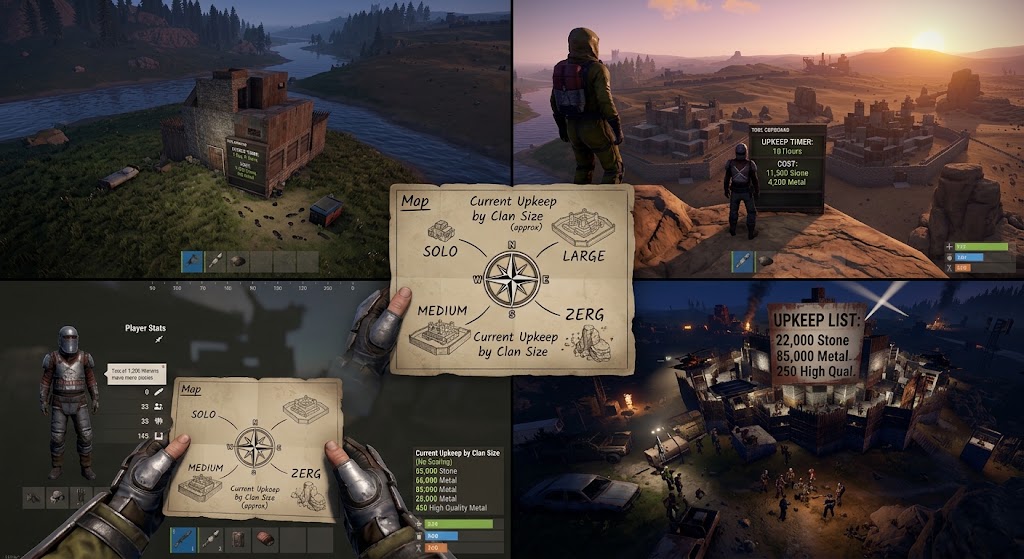
The September 2026 Breach and Clear update introduced one of the biggest changes to base maintenance in Rust: Upkeep Group Scaling.
Tool Cupboards can now charge additional upkeep depending on how many players are associated with a base. Small groups are unaffected, while larger teams gradually pay more resources to maintain the same base.
The system was added to make large groups consider the cost of maintaining a shared base rather than giving every player count the same upkeep requirements.
How Rust Upkeep Group Scaling Works
Previously, the amount of resources required by a Tool Cupboard was primarily determined by the building itself. The number of players using the base did not directly increase the upkeep cost.
The new system changes this.
Rust now calculates a group upkeep tax based on the number of players connected to the base. The tax is applied on top of the normal Tool Cupboard upkeep.
The first four players are completely exempt from the additional cost.
After that, the upkeep increases in stages:
Players counted
After that, the upkeep increases in stages:
| Players counted | Additional upkeep |
|---|---|
| 1–4 | 0% |
| 5–10 | +2% per player |
| 11+ | +4% per player |
| Maximum | 300% |
This means that small groups can continue maintaining their bases at the normal rate, while larger groups gradually need more resources.
Which Players Count Toward Upkeep?
An important part of the new Rust upkeep system is that simply removing someone from the Tool Cupboard does not immediately remove them from the calculation.
Rust considers several types of authorization.
The player count includes:
- Players currently authorized on the Tool Cupboard.
- Players who were removed from the Tool Cupboard during the previous 24 hours.
- Players authorized on code locks inside the base.
- Players with access through guest codes.
- Players who were removed from code locks during the previous 24 hours.
This prevents groups from simply removing players from the TC or changing access codes whenever they want to avoid the additional upkeep.
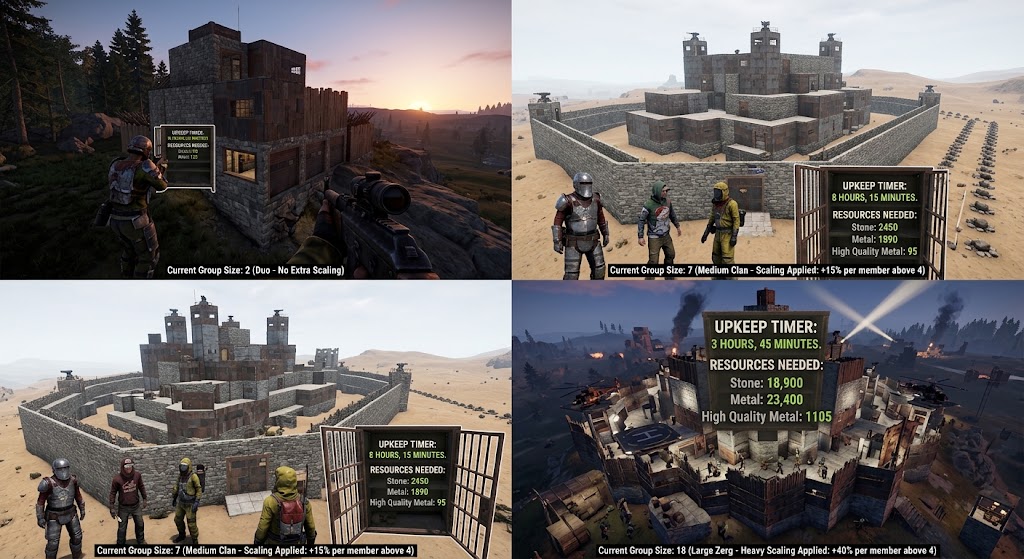
How Much More Does a Large Rust Base Cost?
The additional upkeep is calculated progressively rather than applying one percentage to the entire group as soon as it reaches a certain size.
For example, a base with six counted players has two players above the four-player exemption.
Those two players add:
2 × 2% = 4% additional upkeep
So the same base requires 104% of its normal upkeep.
With twelve counted players, the calculation becomes:
- First 4 players: 0%
- Players 5–10: 6 × 2% = 12%
- Players 11–12: 2 × 4% = 8%
Total:
20% additional upkeep
Therefore, a base with twelve counted players requires 120% of its normal upkeep.
The difference becomes much more noticeable with very large groups. At 20 counted players, the additional tax reaches 52%, meaning the base requires 1.52 times its normal upkeep.
The system eventually reaches a maximum of 300% of normal upkeep.
Does Upkeep Group Scaling Affect Solo Players?
No.
Solo players do not receive an additional upkeep tax from this system, and the same applies to groups of up to four counted players.
This means that a solo player, duo, trio or four-player team continues paying the standard Tool Cupboard upkeep for the structure.
The extra cost only begins when the number of counted players reaches five.
This makes the change particularly relevant to larger Rust teams rather than small groups.
Code Locks Now Matter Too
One of the more important details of the new system is that Tool Cupboard authorization is not the only thing that matters.
Players authorized through code locks can also contribute to the group count.
That means a large base with many shared doors and access codes can have a higher upkeep cost even if fewer players are directly authorized on the Tool Cupboard.
Guest code access is also included in the calculation.
This makes access management more important for large bases. Groups need to keep track of who has access to their building rather than only looking at the TC authorization list.
Removing Players Does Not Immediately Reduce Upkeep
Another important detail is the 24-hour period.
If a player is removed from the Tool Cupboard or a code lock, that player can still count toward the upkeep calculation for the next 24 hours.
This prevents a simple workaround where a large clan could remove everyone from the TC just before the upkeep calculation and immediately return to the lower cost.
For large groups, the upkeep calculation therefore reflects recent access to the base rather than only the exact list of players authorized at that moment.
How to Check Your Current Upkeep Tax
Rust provides an easy way to see the additional upkeep being applied.
Open the Tool Cupboard and hover over the upkeep cost.
The game displays the current tax being applied to the base, allowing players to see how their group size affects the required resources.
This is particularly useful for large clans because the normal upkeep shown by the building itself may not tell the whole story.
Why Did Rust Add Group Upkeep Scaling?
Facepunch described large player groups as a difficult balance problem because having more players naturally allows a team to overcome many of Rust's challenges through sheer numbers.
The new upkeep system adds another resource-management consideration for large groups without increasing the base cost for solo players and small teams.
Instead of making large groups impossible to maintain, the system makes their larger population come with a corresponding maintenance cost.
This also creates another strategic decision for large clans: maintaining a huge shared base now requires more resources than maintaining the same structure with a small team.
What Large Rust Groups Should Know
The most important thing to remember is that group size is now part of base upkeep.
Large teams should pay attention to:
- Who is authorized on the Tool Cupboard.
- Who has access through code locks.
- Guest code access.
- Players recently removed from the base.
- The additional percentage shown by the TC.
- The amount of resources required for each upkeep cycle.
For smaller groups, there is no additional tax until the fourth-player limit is exceeded.
For larger groups, the cost increases progressively and can eventually become several times higher than the standard upkeep.
Rust Upkeep Group Scaling in the September 2026 Update
Upkeep Group Scaling is part of Rust's September 3, 2026 Breach and Clear update. The same update introduced Monument Blockers, breakable Attack Helicopter armor, new HQM nodes, the Medical Honey Bandage and several other gameplay and performance changes.
The new system adds another layer of base management to Rust. Building a larger base with a larger team is still possible, but the number of players using and accessing that base now directly affects how much upkeep it requires.
For solo players and small teams, the change is minimal. For large clans, however, keeping track of player access and Tool Cupboard upkeep is now an important part of managing a base.