 Servers-Rust.org
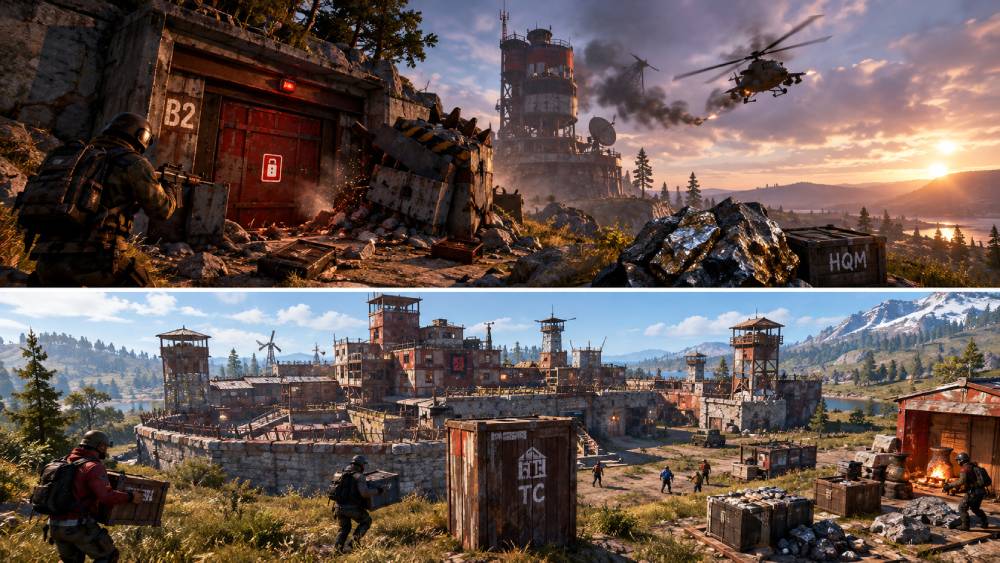
Tool Cupboards are one of the most important parts of building and maintaining a base in Rust. They control building privilege, prevent unauthorized players from constructing inside your base, and determine how many resources are consumed by a building over time.
With the September 2026 Breach and Clear update, Facepunch introduced a new change to Tool Cupboard upkeep: group size now affects upkeep costs.
The change adds another economic consideration for large groups and clans. Instead of looking only at the size of a base, players now also need to consider how many people are associated with the group when planning their long-term resource requirements.
What Is Tool Cupboard Upkeep in Rust?
Tool Cupboard upkeep is the amount of resources required to keep a building protected by a Tool Cupboard.
When players place building blocks such as foundations, walls, floors and other structures, the Tool Cupboard calculates the resources required to maintain those structures.
Players must regularly place the required resources inside the Tool Cupboard. If the necessary resources are not available, the building will eventually start to decay.
This system is one of the main mechanics that prevents players from creating enormous permanent bases without continuously investing resources into them.
For example, a small starter base might require only a modest amount of wood, stone or metal fragments to maintain. A large compound with multiple layers of walls, towers and armored structures can require significantly more resources.
The bigger the base becomes, the more expensive it is to maintain.
What Changed in the September 2026 Rust Update?
The September 2026 update introduced group size TC upkeep scaling.
Facepunch lists the feature in the official September changelist as "Group size TC upkeep increase."
The idea is relatively straightforward: larger groups can now face increased Tool Cupboard upkeep costs.
This creates a stronger connection between the number of players in a group and the resources required to maintain its infrastructure.
A large clan can have many players farming resources, defending the base and gathering materials. At the same time, a large group can potentially occupy a significant amount of territory and maintain a much larger compound than a solo player or small team.
The new scaling system adds an additional cost to that advantage.
Why Does Group Size Matter?
Rust has always had a significant difference between solo players, small teams and large clans.
A large group can distribute responsibilities between many players.
One player might gather sulfur, another can farm stone, others can collect components, while another group handles monuments, electricity, vehicles or PvP.
This makes it possible for large groups to build enormous compounds relatively quickly.
The Tool Cupboard upkeep system is designed to create a continuous resource cost for maintaining those structures.
With group scaling, the economic cost can now increase alongside the size of the group.
This means that a clan has another reason to think carefully about how much territory it actually needs.
Large Bases Become a Bigger Economic Commitment
One of the most important consequences of the change is that large compounds can become more expensive to operate.
In Rust, building a massive base can provide several advantages.
A larger compound can provide additional storage space, vehicle protection, external walls, shooting positions, multiple Tool Cupboards and additional room for future expansion.
However, every additional structure can increase the amount of resources required to maintain the compound.
When group size is also taken into account, large clans have to consider two separate factors:
- How large is the base?
- How many players are part of the group?
This makes base design more important.
A clan that builds far beyond what it actually needs could spend considerable amounts of resources simply keeping the structure from decaying.
What Does This Mean for Small Groups?
The change is particularly interesting for small groups.
Solo players, duos and trios generally have fewer players available to gather resources than large clans.
However, smaller groups also tend to build smaller and more efficient bases.
That means a compact base can potentially be easier to maintain over a long wipe.
Instead of attempting to copy the enormous compounds used by large clans, smaller teams can focus on efficient layouts with less unnecessary building.
This can reduce the amount of resources required for upkeep and allow players to spend more time on progression, weapons, monuments and PvP.
Base Efficiency Becomes More Important
Efficient base design has always been valuable in Rust, but group-based upkeep gives it another reason to matter.
Players should consider whether every additional wall, floor, tower or external structure provides a useful defensive benefit.
A large compound can look impressive, but appearance alone does not make a base efficient.
Every unnecessary building block can contribute to the long-term cost of maintaining the base.
This is especially important during longer wipes when the same base may need to be maintained for several weeks.
Efficient building can therefore save resources that can instead be used for weapons, explosives, ammunition, vehicles and other equipment.
Clan Bases and External Building
Large groups frequently use external Tool Cupboards to expand their building privilege around the main compound.
External walls, gatehouses and other defensive structures can significantly increase the footprint of a base.
These structures are useful for protecting the main building and controlling access to the surrounding area, but they also contribute to the overall maintenance requirements of the compound.
With group-based upkeep scaling, clans may need to pay even more attention to the total amount of infrastructure they maintain.
This could encourage some groups to build more compact compounds rather than automatically expanding their territory.
Resource Management During a Wipe
Upkeep becomes especially important immediately after a wipe.
During the early stages of a wipe, players usually have limited access to high-tier resources.
Teams are simultaneously trying to obtain better weapons, upgrade workbenches, secure monuments and gather materials for their main base.
Spending too many resources on an oversized compound can slow down progression.
A balanced approach is therefore important.
A group may want to start with a relatively compact base and expand later after establishing reliable farming routes and resource production.
This is particularly useful for groups that are not able to maintain a large farming operation throughout the entire wipe.
Does This Change the Rust Meta?
The September 2026 change does not remove large clans from Rust or prevent them from building large bases.
Instead, it adds another cost to maintaining large-scale infrastructure.
Facepunch has continued introducing systems that create more interaction between different parts of Rust's gameplay. The August 2026 Power Trip update, for example, introduced Player Maintained Monuments and required players to interact with the Power Plant and Heavy Fuses to restore certain functionality.
The September update continues this approach by adding economic considerations to group size.
Large teams still have access to the benefits of having more players, but maintaining those advantages can require more resources.
Tips for Managing TC Upkeep
Players can reduce the pressure of upkeep by following a few simple principles.
Build Only What You Need
Avoid adding unnecessary structures to the main compound. Every additional building piece can increase the overall maintenance requirement.
Keep Resources in Reserve
Do not leave the Tool Cupboard with only the exact amount required for the current upkeep period. Maintaining a reserve can protect the base if the group cannot farm for several days.
Expand Gradually
Instead of immediately building the biggest possible compound, consider expanding after the group has established reliable resource income.
Separate Infrastructure When Necessary
Large compounds can become expensive to maintain. Carefully planned external structures can provide defensive benefits without turning the entire base into an inefficient collection of unnecessary building pieces.
Consider the Size of Your Group
The number of players in a group is now another factor worth considering when planning a base.
A base designed for a small team may not remain equally efficient after the group grows substantially.
The Bigger Picture
Tool Cupboard upkeep is one of the systems that keeps Rust's building economy moving.
Players gather resources, construct bases, defend them and continuously invest materials to keep their structures standing.
The September 2026 group scaling change adds another layer to this system by connecting maintenance costs with group size.
For large clans, this means that maintaining huge compounds can require additional resources. For smaller teams, it reinforces the value of compact and efficient base designs.
The result is not a completely new building system, but it does make the relationship between group size, base size and resource management more important than before.
As Rust continues to evolve through monthly updates, these smaller systems can have a significant effect on how players approach wipes. The best base is not necessarily the largest one — it is the one a group can actually afford to maintain.