Servers-Rust.org
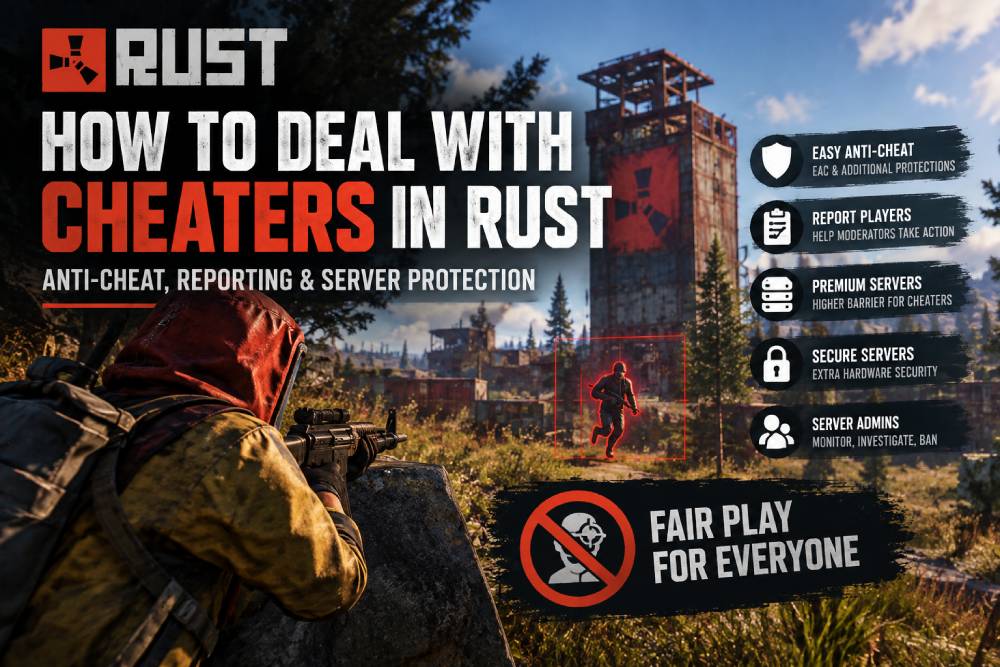
How to Deal With Cheaters in Rust: Anti-Cheat, Reports and Server Protection
Cheating has always been one of the biggest problems in Rust. ESP, aimbots, recoil scripts and other forms of cheating can quickly ruin a wipe, especially on competitive PvP servers.
Facepunch continues to invest in anti-cheat technology, player reports, server-side protections and additional security systems. In its January 2026 review, Facepunch reported more than 338,000 Rust bans during 2025, including more than 296,000 permanent bans and approximately 16 million cheat reports. The studio also said that the majority of detected cheaters were being removed in less than seven hours of playtime.
So what can players and server owners actually do when they encounter a suspected cheater?
How to Recognize a Cheater in Rust
Not every suspicious death is proof of cheating.
Rust has a large skill gap, and experienced players can sometimes look suspicious to newer players. Good aim, game knowledge, sound awareness and knowledge of common building locations can all make a player appear much better than expected.
Before reporting someone, look for repeated and unusual behavior.
Possible warning signs include:
- Consistently tracking players through solid terrain
- Extremely suspicious headshot accuracy
- Recoil patterns that appear unusually consistent
- Knowing the exact location of players without an obvious information source
- Shooting accurately at players who are completely hidden
- Unusual movement or impossible-looking interactions
- Repeatedly finding hidden players or bases without an apparent reason
A single suspicious kill is usually not enough to establish that someone is cheating.
Repeated behavior across multiple encounters provides much stronger evidence.
Record Evidence Before Reporting
If you believe someone is cheating, collect as much useful information as possible.
Useful evidence can include:
- Player name
- SteamID
- Server name
- Approximate time of the incident
- Video recording
- Relevant gameplay footage
- Description of the suspicious behavior
Video evidence is particularly useful because it allows the situation to be reviewed rather than relying only on a player's impression immediately after dying.
Avoid editing the footage in a way that removes the important context. A short clip showing the suspicious moment together with enough gameplay before and after it can be much more useful than an isolated screenshot.
Report Suspected Cheaters
Reporting suspicious players is one of the most important things ordinary players can do.
Facepunch has repeatedly emphasized the importance of player reports because reports provide information that can be investigated alongside other anti-cheat signals.
Facepunch reported receiving approximately 16 million cheat reports during 2025, a 28% increase compared with the previous year.
When making a report, provide factual information rather than simply saying that someone is cheating.
For example, instead of:
"This player is definitely using ESP."
Explain what happened:
"The player tracked me through the rock for approximately 10 seconds and started shooting immediately after I moved behind cover."
This gives investigators more useful information.
Rust Uses Easy Anti-Cheat
Rust works with Easy Anti-Cheat (EAC) as part of its anti-cheat system.
Facepunch does not publish detailed information about exactly how its anti-cheat systems detect every type of cheat. The developers have explained that revealing too much information could help cheat developers bypass detection.
This means players should not expect every anti-cheat change to appear as a detailed public announcement.
Facepunch has also continued working with the EAC team on detecting and blocking cheating.
In its 2026 review of 2025, Facepunch specifically mentioned additional EAC efforts targeting recoil cheats, often referred to as scripting.
Server-Side Player Culling
One of the important technical improvements introduced by Facepunch is server-side player culling.
The system can prevent the server from networking players who are completely hidden behind terrain or rocks.
This has an important anti-cheat benefit because some cheating tools rely on receiving information about players who should not be visible to the client.
Facepunch enabled server-side player culling by default across all servers in May 2025 and said it can prevent or significantly limit certain high-impact cheat features, including some ESP and aimbot capabilities.
This is a good example of why anti-cheat is not only about detecting suspicious software.
Another approach is to reduce the information that a cheating client can receive in the first place.
Premium Rust Servers
Facepunch also introduced Premium Servers as another way to reduce cheating.
Premium Servers require a player's Rust Steam inventory to have a value of at least $15.
The idea is to make it more expensive and inconvenient for banned players to return with new accounts.
Facepunch reported that Premium Servers were successful at reducing cheating and said that they provided a stronger gate against cheaters than ordinary servers.
An earlier Facepunch update reported that players on Premium Servers encountered cheaters around four times less often than players on regular servers during the initial evaluation.
Premium access is therefore one option for players who want a more controlled competitive environment.
Secure Rust Servers
Rust has also introduced Secure Servers with additional hardware security requirements.
These servers require features such as TPM 2.0 and Secure Boot.
In its Spring Clean update, Facepunch reported an initial measurable reduction in cheaters on Secure Servers. The early sample showed approximately one cheater in 63 players on the secure servers compared with approximately one in 42 on regular servers.
Facepunch also noted that the initial sample was relatively small because the secure-server rollout started with only six servers, so the results were not considered a perfect representation of the overall player base.
The approach is another example of Rust moving toward multiple layers of protection instead of relying on a single anti-cheat system.
What Rust Server Owners Can Do
Server administrators have an additional responsibility because they control the environment in which their community plays.
A good anti-cheat strategy should combine several approaches.
Monitor Reports
Keep track of player complaints and reports.
Multiple independent reports about the same player can provide useful information, especially when they describe similar behavior.
Review Evidence
Do not automatically ban someone because another player is angry after losing a raid.
Review available evidence and look for repeated suspicious behavior.
Use Server Administration Tools
Rust provides administrators with tools for managing players and server access.
Server owners can use administrator and moderator permissions to investigate incidents and take appropriate server-level action.
Maintain Clear Rules
A server should clearly explain:
- What constitutes cheating
- How players should report suspected cheaters
- What evidence is useful
- How administrators investigate reports
- What happens after a confirmed violation
Clear rules help prevent unnecessary arguments between players and administrators.
Centralized Banning for Multiple Rust Servers
Server networks can also use Centralized Banning.
Rust supports an external ban list that can be shared between multiple servers.
When configured, a dedicated server can query the centralized ban API when a player attempts to join. This allows server owners running several servers to maintain a synchronized ban list rather than managing every server independently.
This can be particularly useful for larger Rust communities operating several servers under.